



/twitter-x.svg)




/twitter-x-red.svg)
April 20, 2026
EXECUTIVE SUMMARY
• Air Freight: The Baltic Air Freight Index (BAI00) rose 5.1% last week and is up 15.8% compared to this time last year. Middle East airspace closures are pushing airlines to fly longer routes, which uses up capacity and keeps rates high.
• Ocean Freight: The Drewry World Container Index fell 3% to $2,246/40ft, ending a six-week climb. But rates on routes to the U.S. are still well above where they started the year, and carriers are adding a new Peak Season Surcharge of $2,000/40ft starting May 1.
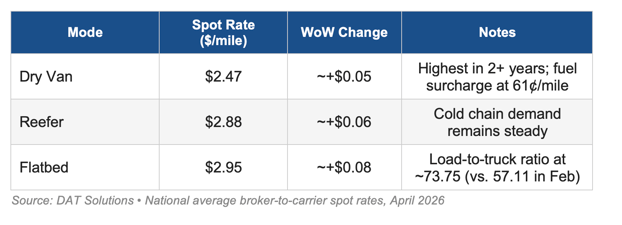
• North American Trucking: Spot rates hit two-year highs in March and stayed elevated in April — dry van at $2.47/mile, reefer at $2.88/mile, flatbed at $2.95/mile. Diesel costs are the main driver.
• Trade Compliance: A major Section 232 overhaul took effect April 6: all steel and aluminum imports now face a 50% tariff based on full customs value, and all prior exemptions have been removed. The IEEPA tariff refund portal opened today (April 20).
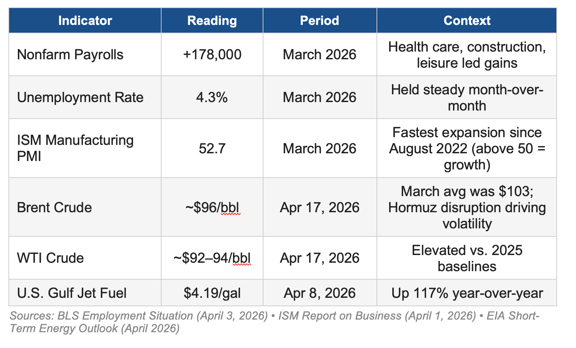
• Economy & Commodities: Brent crude was near $96/barrel on April 17, swinging sharply on Strait of Hormuz news. The U.S. added 178,000 jobs in March and the ISM Manufacturing Index hit 52.7 — its strongest reading since August 2022.
AIR FREIGHT INSIGHTS
The Baltic Air Freight Index (BAI00) rose 5.1% in the week ending April 6 and is now 15.8% higher than a year ago. The biggest reason isn’t a spike in demand — it’s a shortage of usable capacity. The ongoing conflict in the Middle East has closed key airspace routes, forcing cargo airlines to fly longer paths around restricted zones. That eats up aircraft time and availability.
Some shipping lanes are being hit harder than others. Cargo leaving Hong Kong (BAI30) rose 8.6% last week and is up 13.4% year-over-year. Shanghai outbound (BAI80) gained 6.4% last week and is up 21.3% from a year ago. On Europe-originating routes, London Heathrow (BAI40) has surged 48.8% year-over-year as disruption to Gulf hub airports redirects more freight through UK entry points.
Jet fuel costs are adding to the pressure. As of April 8, U.S. Gulf Coast jet fuel stood at $4.19 per gallon — up 117% compared to a year ago. Airlines are passing those costs through to shippers. IATA projects airlines will carry 71.6 million tonnes of cargo in 2026, but industry analysts say the Middle East disruption could limit how much of that growth actually happens.
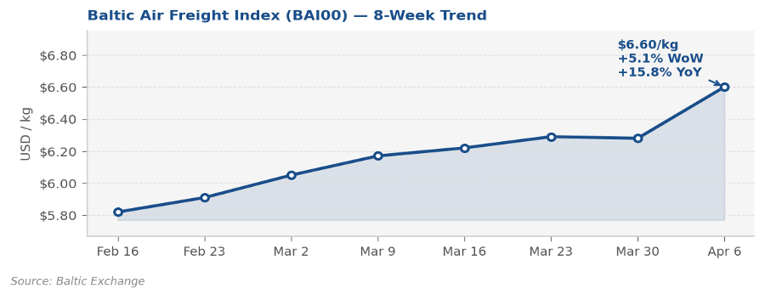
Source: Baltic Air Freight Index (BAI00) — 8-Week Trend
| ⚠️ What this means: Air freight costs on routes through or near the Middle East are running well above last year’s levels. Longer routing adds both cost and transit time. Shippers moving cargo from Asia or through Gulf hubs should plan for delays and higher-than-normal costs through at least Q2 2026. |
OCEAN FREIGHT INSIGHTS
The Drewry World Container Index (WCI) dropped 3% to $2,246 per 40-foot container as of April 16 — the first weekly decline after a six-week run-up. Spot rates from Shanghai fell 3% to New York ($3,552), Los Angeles ($2,810), and Rotterdam ($2,229). Despite this pullback, rates on Asia-to-U.S. routes are still more than 50% above where they were in late February.
The Strait of Hormuz, one of the world’s most important waterways for oil and shipping, remains effectively closed due to the U.S. naval blockade of Iran. This forces ships to reroute around the Cape of Good Hope in southern Africa, adding 10–14 days to Asia-Europe voyages and driving up operating costs. Global container capacity reached about 16.4 million TEU in scheduled services, but the longer routes eat into that available space.
Transatlantic rates jumped 50% in a single week — from about $1,400 to over $2,100 per FEU — as surcharges took effect. Several major carriers have announced a Peak Season Surcharge (PSS) of ~$2,000/40ft effective May 1. Emergency bunker surcharges and war-risk charges are also active across multiple trade lanes. On the positive side, dwell times at the Los Angeles/Long Beach ports improved in March, averaging 4.41 days — down from 5.10 in February.
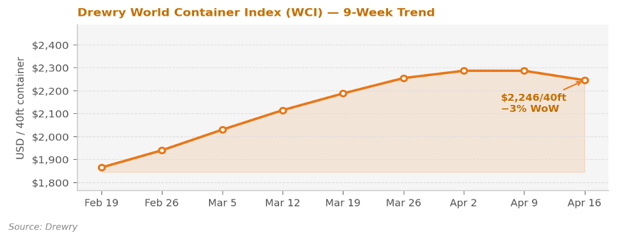
Source: Drewry World Container Index (WCI) — 9-Week Trend
| ⚠️ What this means: Ocean rates pulled back slightly this week on some lanes, but the overall environment remains elevated. A new carrier surcharge kicks in May 1, and Hormuz disruption continues to add cost and time to routes through the Gulf. Shippers should be aware that transit times are longer than normal on Europe-routed cargo. |
NORTH AMERICAN TRUCKING
Truck freight rates reached their highest point in more than two years in March, and April data shows rates holding firm. The main driver is diesel: the average fuel surcharge for van freight jumped from 41 cents to 61 cents per mile — the highest since late 2022. That extra cost flows directly into spot and contract rates across all equipment types. Full-year 2026 truckload costs are now projected up 16–17% compared to last year.
Flatbed is the tightest market right now. The load-to-truck ratio reached about 73.75 loads per available truck nationally, up from 57.11 in February. That means carriers have far more loads competing for their trucks than usual. The Northeast is the tightest region, with Atlanta and Philadelphia showing the largest rate increases. DOT Roadcheck Week (May 12–14) may further tighten available capacity during that window.
DAT Spot Rate Summary — April 2026
TRADE COMPLIANCE / US CUSTOMS UPDATES
Section 232 Tariffs Restructured — Effective April 6
The U.S. government restructured Section 232 tariffs on steel, aluminum, and copper on April 2, with the changes taking effect April 6. The key change: duties now apply to the full customs value of imported goods — not a partial basis as before. All prior country-specific and product-specific exemptions have been eliminated. The new rates are 50% on steel and aluminum mill products, regardless of where they come from.
IEEPA Refund Window Opens Today — April 20
CBP launched the CAPE refund system today for importers who may have overpaid duties under previous IEEPA tariff actions. Phase 1 covers unliquidated entries and those liquidated within the past 80 days. Only the Importer of Record or the customs broker who filed the original entry can submit a claim. CBP estimates a processing window of up to 45 days.
Looking Ahead: Pharmaceutical Tariffs
Section 232 tariffs on pharmaceutical products are set to begin July 31, 2026. Companies importing drugs, active pharmaceutical ingredients (APIs), or pharma intermediates should begin reviewing their supply chain exposure now.
WORLD NEWS & COMMODITIES
Oil prices remain a key cost driver across the supply chain. As of April 17, Brent crude was near $96/barrel and WTI near $92–94/barrel. The market has been extremely volatile — prices dropped more than 10% in one day after Iran signaled a temporary ceasefire opening the Strait of Hormuz, then shot back up over 5% when the U.S. Navy seized an Iranian cargo vessel in the Gulf of Oman. Brent averaged $103/barrel in March, and the EIA projects it could peak near $115/barrel in Q2 2026.
The Strait of Hormuz remains the central pressure point for global shipping. The strait carries roughly 20% of the world’s daily oil supply. Its effective closure has pushed up jet fuel costs (now 117% above last year), increased ocean bunker surcharges, and disrupted cargo routing across the Middle East, South Asia, and beyond.
Economic Pulse: Jobs Report & ISM Manufacturing
WHAT THIS MEANS FOR YOUR SUPPLY CHAIN
Right now, costs are rising across every mode of transportation. Air freight is up due to fuel and rerouting. Ocean freight has a new carrier surcharge coming in May. Trucking rates are at a two-year high fueled by diesel costs. And major tariff changes have already changed the math on imports of steel and aluminum.
If you import steel, aluminum, or copper: The April 6 Section 232 restructuring has changed how duties are calculated. All prior exemptions are gone and the duty now applies to the full customs value of the import. Reviewing your landed cost calculations is an important step.
If you move goods through the Middle East, Gulf, or South Asia: Both air and ocean routes through these regions are being rerouted, taking longer and costing more. Transit times on Asia-Europe ocean lanes are running 10–14 days longer than normal. Air freight from South Asia is 62% above pre-conflict rates on some lanes.
If you move domestic truckload freight: Rates across all equipment types are at multi-year highs. Flatbed capacity is especially tight. DOT Roadcheck Week in mid-May may further limit available trucks during that window.
| The BTX team monitors these markets daily. If any of the trends in this report affect your specific lanes or commodities, reach out to your account manager — we’re here to help you move smarter. |
SOURCES
– Baltic Exchange — Baltic Air Freight Index (BAI00, BAI30, BAI40, BAI80): week ending April 6, 2026
– Air Cargo News — "Rates remain elevated and return to normal not expected soon" (April 2026)
– Air Cargo Week — "Global air cargo capacity falls 1% as Middle East disruption delays recovery"
– Freightos — Weekly Freight Updates: April 7 and April 14, 2026
– Drewry — World Container Index (WCI): April 16, 2026
– Xeneta — Weekly Ocean Container Shipping Market Update, April 17, 2026
– PMSA — San Pedro Bay Container Dwell Times, March 2026
– DAT Solutions — "Truckload freight rates hit two-year highs as diesel costs surge" (April 14, 2026)
– U.S. Bank / DAT — Quarterly Truck Freight Rates Report (April 1, 2026)
– GEODIS — Section 232 Tariff Changes Effective April 6, 2026
– Flexport — IEEPA Tariff Ruling: Next Steps and Potential Refunds
– EIA — Short-Term Energy Outlook, April 2026; Crude Oil Price Reports
– CNBC / Fortune — Oil price updates, April 14 and 17, 2026
– BLS — Employment Situation Summary: March 2026 (released April 3, 2026)
– ISM — Manufacturing PMI Report on Business: March 2026
– IATA — 2026 Air Cargo Forecast (71.6 million tonnes)
– C.H. Robinson — Freight Market Update: April 2026
This report is produced weekly by BTX Global Logistics for informational purposes only. All data reflects publicly available information at time of publication.




.png)