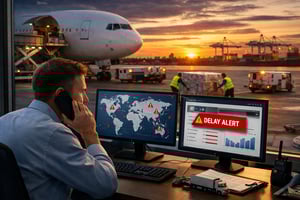

In today’s freight environment, uncertainty is no longer an exception — it’s the baseline.
The Strategic Role of Air Freight in Modern Supply Chains: When Speed Becomes a Competitive Advantage
In global logistics, speed is often viewed as a luxury.
Ocean freight is cheaper.
Ground freight is predictable.
Warehousing offers buffer capacity.
So air freight is frequently reserved for “emergencies.”
But that mindset is outdated.
In today’s supply chain environment—where customer expectations are measured in hours, not weeks—air freight is no longer just a backup plan. It’s a strategic lever.
For manufacturers, distributors, healthcare suppliers, technology brands, and retail networks, air cargo has become a powerful tool to:
- Protect revenue
- Prevent line-down scenarios
- Reduce inventory carrying costs
- Enter new markets faster
- Recover from disruption
- Gain a competitive edge
This guide explains when air freight makes financial and operational sense—and how modern logistics teams use it strategically, not reactively.
What Is Air Freight?
Air freight (also called air cargo) refers to the transportation of goods via aircraft—either dedicated cargo planes or commercial passenger aircraft with cargo capacity.
Unlike ocean freight, which can take weeks, air freight typically moves internationally in:
- 1–3 days for express shipments
- 3–7 days for standard air cargo
It is the fastest mode of international transportation available at scale.
But speed alone doesn’t justify its use.
The question is: When does the speed of air freight offset its higher cost?
When Air Freight Makes Financial Sense
Air freight is often perceived as expensive. On a per-kilogram basis, it usually is.
But logistics decisions should be based on total landed cost, not just freight rate.
Here are the scenarios where air freight creates measurable ROI:
1. Preventing Production Downtime
For manufacturers, a delayed component can shut down an entire production line.
The cost of a line-down event can range from thousands to millions of dollars per day.
In this scenario:
- Paying a premium for air freight is not a cost.
- It is insurance against catastrophic operational loss.
2. Launching High-Margin Products
Technology launches, seasonal apparel drops, medical equipment rollouts, and promotional campaigns often carry tight timelines.
If product arrival misses the launch window, revenue opportunity disappears.
Air freight protects revenue timing.
3. Reducing Inventory Carrying Costs
Holding excess inventory to compensate for long ocean transit times increases:
- Warehouse costs
- Insurance costs
- Capital lock-up
- Obsolescence risk
Shorter transit times via air can reduce the need for safety stock and free working capital.
4. Recovering from Supply Chain Disruptions
Port congestion. Labor strikes. Weather events. Customs delays.
When disruption hits, air freight becomes a recovery tool—helping companies rebalance supply chains quickly.
Air Freight vs. Ocean Freight: Strategic Comparison
| Factor | Air Freight | Ocean Freight |
|---|---|---|
| Speed | 1–7 days | 20–45 days |
| Cost per unit | Higher | Lower |
| Inventory impact | Lower safety stock | Higher safety stock |
| Reliability | Higher predictability | Port & vessel delays common |
| Best for | High-value, time-sensitive goods | Bulk, low-margin cargo |
The choice isn’t about “which is better.”
It’s about aligning mode with business objectives.
Many global supply chains use a hybrid strategy:
- Core volume by ocean
- Critical replenishment by air
Industries That Rely on Air Freight
Air freight isn’t limited to one sector. It supports a wide range of industries where time sensitivity matters.
Healthcare & Pharmaceuticals
- Medical devices
- Diagnostic equipment
- Temperature-controlled pharmaceuticals
- Emergency replacement parts
In healthcare, speed directly impacts patient outcomes.
Technology & Electronics
- High-value components
- Semiconductor supply
- Consumer electronics launches
- Warranty replacement parts
Technology products lose value quickly. Faster delivery protects margins.
Automotive & Manufacturing
- Just-in-time components
- Production-critical machinery parts
- Emergency restocking
Even a small missing component can halt entire production systems.
Retail & E-commerce
- Seasonal inventory
- Promotional campaigns
- High-demand SKUs
- Market-entry inventory
Retail timelines are unforgiving. Air freight helps brands hit shelves on schedule.
The Hidden Advantages of Air Freight
Speed is obvious. But there are other benefits often overlooked.
Reduced Damage Risk
Shorter transit times and less handling reduce:
- Moisture exposure
- Port congestion damage
- Container stacking compression
For high-value goods, this matters.
Improved Predictability
Air freight schedules are generally more stable than ocean sailings affected by:
- Port congestion
- Blank sailings
- Labor disputes
- Vessel rollovers
Predictability improves planning accuracy.
Faster Customs Clearance
Air shipments often move through dedicated cargo terminals with streamlined clearance processes.
This accelerates entry into destination markets.
Air Freight and Supply Chain Agility
Modern logistics isn’t about lowest cost.
It’s about agility.
Companies that can pivot faster gain market share.
Air freight enables:
- Rapid geographic expansion
- Emergency supplier diversification
- Inventory rebalancing between regions
- Faster response to demand spikes
Agility is now a competitive advantage—not just an operational metric.
Common Misconceptions About Air Freight
“Air freight is always too expensive.”
It depends on what you’re comparing it to.
When factoring:
- Inventory holding costs
- Lost sales
- Production downtime
- Expedited recovery
Air freight may actually lower total cost of disruption.
“It’s only for small shipments.”
Air cargo handles everything from small parcels to large palletized freight.
Many wide-body aircraft carry substantial cargo capacity.
“It’s only for emergencies.”
Leading supply chains use air freight proactively—not just reactively.
How to Decide If Air Freight Is Right for Your Shipment
Logistics teams typically evaluate:
- Value per kilogram
- Time sensitivity
- Revenue at risk
- Production dependency
- Customer service impact
- Inventory buffer levels
- Supply chain volatility
If delay risk exceeds freight premium, air freight becomes strategic—not optional.
Air Freight and Global Network Integration
Air cargo doesn’t operate in isolation.
It integrates with:
- Ground pickup and final mile delivery
- Customs brokerage
- Warehousing
- Cross-docking
- Multimodal logistics strategies
A coordinated logistics partner ensures smooth handoffs and visibility across the shipment lifecycle.
The Future of Air Freight
Air cargo continues evolving with:
- Improved tracking technology
- Enhanced real-time visibility
- Smarter route optimization
- Sustainable aviation fuel initiatives
- Data-driven capacity planning
As supply chains become more dynamic, the role of air freight will continue to expand.
It will not replace ocean freight—but it will increasingly support it as part of resilient logistics architecture.
FAQs
Is air freight more reliable than ocean freight?
Generally, yes. Air freight schedules are less impacted by port congestion and vessel delays, offering higher predictability.
How much faster is air freight compared to sea freight?
Air freight typically moves internationally in 1–7 days, while ocean freight often takes 20–45 days depending on route.
What products are best suited for air freight?
High-value, time-sensitive, perishable, or production-critical goods are best suited for air transportation.
Does air freight reduce inventory costs?
Yes. Faster transit times can reduce safety stock requirements and lower inventory carrying costs.
When should a company switch from ocean to air freight?
Companies often switch when facing supply chain disruption, production risk, seasonal demand spikes, or urgent replenishment needs.
Final Thoughts: Speed Is a Strategy
Air freight should not be viewed as a panic button.
It is a strategic instrument.
In an environment where supply chain volatility is the norm, the companies that win are not those with the cheapest freight—they are the ones with the most adaptable logistics strategy.
When used intelligently, air freight:
- Protects revenue
- Reduces operational risk
- Enhances agility
- Improves customer satisfaction
- Strengthens global competitiveness
The question is not whether air freight is expensive.
The question is whether delay is more expensive.
For many organizations, the answer is clear.